
Quartz Kitchen Countertops: A Practical Guide
Quartz isn't a mined stone — it's engineered from crushed natural quartz and resin, and that difference is exactly why it's become the default countertop for modern kitchens.
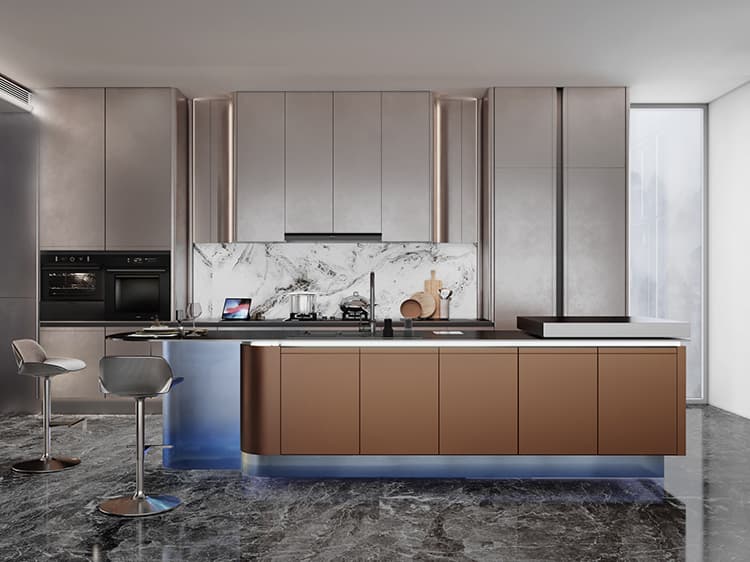
Quartz countertops are engineered stone surfaces made from roughly 90–95% crushed natural quartz combined with polymer resins and pigment, compressed and cured into a slab. Because it's manufactured rather than quarried, quartz has a nonporous surface and a far more consistent pattern than natural stone — which is why it has become the default countertop material for modern kitchens over the past decade.
What Is Quartz, Exactly, and How Is It Different from Granite or Marble?
Granite and marble are natural stone, cut directly from quarried slabs — every piece is geologically unique, and both are porous enough that they need periodic sealing to resist staining. Quartz starts as ground natural stone but is engineered: the resin binder fills in the microscopic pores that make granite and marble porous, producing a surface that doesn't need sealing and resists staining from wine, oil, and acidic foods far more reliably.
The tradeoff is character. Natural stone has movement and veining no two slabs share; quartz patterns are manufactured, so while modern quartz lines do a convincing job of replicating marble veining, an experienced eye can usually tell them apart up close.
Why Do Modern Kitchens Default to Quartz?
Three reasons show up in almost every design conversation: consistency, low maintenance, and durability. A quartz slab looks essentially identical from one end to the other and matches from one order to the next, which matters enormously on a large island or when countertop and backsplash need to read as one continuous surface. It never needs sealing. And its resin-bound structure resists chips and scratches from everyday kitchen use better than marble, which is soft enough to scratch with a knife dragged directly across it.
Is Quartz More Durable Than Granite?
For daily kitchen use, yes, in most practical respects. Quartz resists scratching and staining better than granite because its surface has no pores for liquid to penetrate. Where granite pulls ahead is heat: quartz's resin binder means a very hot pan set directly on the surface can cause localized damage or discoloration over time, while granite tolerates direct heat better. In practice this is a non-issue with a trivet, but it's the one place where "quartz beats granite at everything" isn't quite accurate.
Quartz vs. Granite vs. Marble: A Practical Comparison
| | Quartz | Granite | Marble | |---|---|---|---| | Material | Engineered (crushed stone + resin) | Natural stone | Natural stone | | Porosity | Nonporous | Porous — needs sealing | Porous — needs sealing | | Stain resistance | Excellent | Good (with sealing) | Fair, even sealed | | Scratch resistance | Very good | Very good | Poor — soft stone | | Heat tolerance | Good, avoid direct contact | Excellent | Good | | Pattern consistency | High, slab to slab | Low, unique per slab | Low, unique per slab | | Typical cost tier | Mid to premium | Mid to premium | Premium |
How Do I Choose the Right Quartz Slab and Edge for My Kitchen?
Start with how much veining movement you want. Bold, dramatic veining (often marketed as "Calacatta-style" or "Statuario-style" quartz) reads as a feature wall in its own right and pairs best with simpler cabinet finishes so the two don't compete — see our guide to melamine, lacquer, and PP cabinet finishes for how finish choice interacts with a busy countertop pattern. A quieter, more uniform quartz — solid tones or fine speckle — lets cabinetry and hardware carry more of the visual weight, which is a common pairing with darker or high-gloss lacquer doors.
Edge profile matters more than people expect on a modern kitchen: a squared or mitered "waterfall" edge on an island reads distinctly more contemporary than a bullnose or ogee edge, which tend to read more traditional regardless of the quartz pattern underneath.
What Does Quartz Countertop Maintenance Actually Look Like?
Day to day, it's soap, water, and a soft cloth — no sealing, no stone-specific cleaners required. Avoid abrasive scouring pads on polished finishes, keep hot cookware on a trivet rather than directly on the surface, and clean up strongly pigmented spills (turmeric, some wines) reasonably promptly, though quartz's nonporous surface gives you far more forgiveness on timing than granite or marble would.
Specifying Quartz as Part of a Full Kitchen
Countertop, cabinetry, and hardware read as one design only when they're specified together — a quartz slab chosen after cabinets are already ordered is how mismatched veining and finish tone happen. Suofeiya's materials library includes quartz alongside cabinet finishes and hardware so a designer can hold a slab sample against your actual door and hinge selection before anything is fabricated. See how it comes together on our kitchen design page, or request a quote with your rough layout and we'll bring slab options to the first design call.
Related reading
Hardware
How Soft-Close Hardware Works in a Cabinet
Suofeiya Team ·
That quiet, cushioned close isn't a sensor or a motor. It's a small hydraulic piston doing a very specific job — and it's the hardware detail that tells you the most about how a kitchen was actually built.
Cabinet Finishes
Melamine vs. Lacquer vs. PP Cabinet Finishes
Suofeiya Team ·
Melamine, lacquer, and PP look similar in a showroom and behave completely differently after five years of daily use. Here's how to tell them apart before you sign a quote.